📅 August 28, 2026 | 👤 Author: Gavin
💡 Key Takeaways for Fleet Operators
- Primary Application: Heavy-duty diesel engines powering 20-to-40-ton excavators, such as the Caterpillar C7/C9, Cummins 6BT5.9/6CT8.3, and Komatsu S6D102/S6D107, working under high-load construction or mining operations.
- The Diagnostic Core: Excessive crankcase pressure (blow-by) and sudden cylinder scuffing indicate a critical breakdown of the boundary lubrication oil film between the piston rings and the cylinder liner wall.
- Tatan Professional Engineering Standard: To resolve these issues, Tatan Machinery supplies precision-engineered cylinder liners with an advanced plateau-honed finish. Our strict quality standards require a reduced peak height (Rpk) of less than 0.3 microns (μm) and a reduced valley depth (Rvk) of greater than 1.2 microns (μm), eliminating the destructive wear-in period.
Understanding Blow-by and Compression Loss in Heavy Excavator Engines
For heavy machinery working in challenging environments, engine health directly impacts operational uptime. Among the most common symptoms reported by excavator operators is excessive blow-by—noticeable as white or blue-grey smoke venting continuously from the crankcase breather tube or oil filler cap.
In heavy-duty diesel engines, blow-by occurs when high-pressure combustion gases bypass the piston rings and leak into the crankcase. This pressure degrades engine oil quality by introducing soot and unburnt fuel, which can cause internal components to fail prematurely.
As expert technicians on Heavy Equipment Forums frequently point out:
“A sudden increase in crankcase blow-by is rarely just a piston ring issue. It is almost always a failure of the cylinder wall’s surface topography to retain a consistent oil film, leading to micro-welding between the ring and the bore.”
When the oil film breaks down, localized temperatures at the piston ring reversal zone can exceed 300°C, causing adhesive wear, also known as cylinder scuffing. Once scuffing occurs, the cylinder loses compression, and the engine loses torque, which often causes the excavator to stall (“憋车”) under heavy hydraulic load.

(Source: Goodson Engine Modification & Honing Library)
The Tribology of Cylinder Bores: The Science of Plateau Honing
To prevent scuffing and blow-by, we must examine the microscopic finish of the cylinder liner wall. Tribology—the study of interacting surfaces in relative motion—reveals that the piston-ring-to-cylinder-wall interface is one of the most critical friction zones in an engine.
As noted in a landmark study highlighted by NASA Speed News:
“Research done by Ford Motor Company and the U.S. Department of Energy showed that roughly 45 percent of engine friction comes from the piston-ring-to-cylinder-wall interface. That friction accelerates wear and produces heat, decreasing power output.”
Traditional engine rebuilds often rely on a single-stage coarse hone to size the cylinder. While this produces a classic cross-hatch pattern, the microscopic surface is covered in sharp, jagged metal peaks (measured as Rpk).
When the engine is first started, these sharp peaks act like miniature files, cutting into the new piston rings. This harsh “wear-in” process generates high frictional heat, fills the lubricating oil with microscopic steel debris, and rapidly erodes the piston ring’s tension.
The Plateau Honing Solution
To bypass this destructive wear-in phase, premium replacement liners sourced from Tatan Machinery undergo a specialized multi-stage process called plateau reticulated honing.
- Rough & Fine Honing: Coarse abrasive stones cut deep valleys (measured as Rvk) into the cast iron to act as deep oil storage reservoirs.
- Plateau Finishing: Ultra-fine abrasives or specialized brush tools shear off the sharp peaks, leaving flat, smooth “plateaus” (measured as Rk) that act as stable load-bearing surfaces for the piston rings.
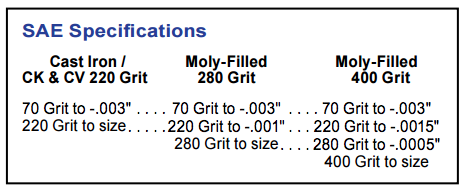
(Source: Performance Motorsports Engine Rebuilding Guide – Showing the structural difference between peak heights and valley depths in plateau honed bores)
This engineered surface ensures that the piston rings seat quickly without wearing down. The flat plateaus distribute the piston’s side-thrust forces evenly, while the deep, cross-hatched valleys retain a continuous reservoir of engine oil to prevent boundary friction, even when operating at maximum torque.
According to research published by SAE International, cylinder liners utilizing precise plateau-honing parameters show a substantial reduction in both initial oil consumption and long-term ring-pack wear, making them highly recommended for high-hour rental fleets and mining equipment.
Step-by-Step Diagnostic Sequence for Crankcase Blow-by
If an excavator engine (such as a Komatsu PC200-8 equipped with an S6D107 engine) exhibits high oil consumption or breathing from the oil cap, follow this step-by-step diagnostic sequence to isolate the fault:
Step 1: Rule Out the Turbocharger and CCV Valve
Before condemning the piston rings, inspect the Crankcase Ventilation (CCV) filter. A clogged CCV element restricts crankcase breathing, artificially inflating crankcase pressure. Next, remove the turbocharger intake pipe and check for axial play in the shaft. Failed turbo seals can push oil and exhaust gases directly into the crankcase, mimicking severe engine wear.
Step 2: Measure Crankcase Pressure Using a Water Manometer
Connect a digital pressure gauge or a water manometer to the dipstick tube.
- Healthy Engine: Crankcase pressure should remain below 1.0 kPa (approx. 4 inches of water) at full load.
- Worn Cylinder/Rings: Pressure exceeding 2.0 to 2.5 kPa indicates that combustion gas is blowing past the piston rings, confirming a seal failure between the ring pack and the cylinder liner wall.
Step 3: Conduct a Cylinder Leak-Down Test
Rotate the engine to place the suspected cylinder at Top Dead Center (TDC) on the compression stroke. Introduce compressed air (approx. 60 PSI) through the injector hole. Listen to where the air escapes:
- If air rushes out of the oil filler neck, the seal between the piston rings and the cylinder wall is broken.
- If air escapes through the exhaust pipe, the exhaust valves or valve train gear alignment is faulty.
Technical Selection: Matching Pistons & Liners for Major Excavator Engines
When sourcing engine rebuild components, understanding material compatibility is critical. Different engine families require distinct cylinder wall coatings and piston ring materials to ensure long-term reliability.
| Engine Model | Typical Machine | Piston Material | Liner Honing Spec | Key Rebuild Consideration |
|---|---|---|---|---|
| Caterpillar C7 / C9 | Cat 324D / 330D | Steel Crown with Aluminum Skirt | Strict Plateau Hone (Rk: 0.5 to 1.2 microns) | Ensure the piston ring kit utilizes a Plasma-Ductile or PVD coating to handle high combustion pressures. |
| Cummins 6BT5.9 | Hyundai R210-5 | Monotherm (One-piece steel) or Alfin | Cross-hatch angle of 35 to 45 degrees for optimal oil retention | Check the crankshaft journal tolerances; heavy-duty operations require high-fatigue copper-lead bearings. |
| Komatsu S6D102 | Komatsu PC200-6 | Aluminum Alloy with Ni-Resist Ring Insert | High Rvk (deep valleys) to prevent dry start-up | Always replace the valve train gears and check the camshaft bushings during a major block overhaul. |
Expert Q&A for Heavy Machinery Engineers
Q1: Why do some newly rebuilt diesel engines continue to blow white smoke and consume oil even after 50 hours of operation?
A: This is almost always due to “glazing” of the cylinder walls. If the cylinder liner was finished with a traditional smooth hone instead of a plateau finish, and the engine was run at light loads immediately after the rebuild, the piston rings fail to seat. Instead, a layer of varnished, partially burnt oil deposits on the cylinder wall, creating a glassy finish. This “glaze” prevents the rings from ever seating properly. The only fix is to remove the pistons and glaze-bust the liners using a flexible hone to recreate the plateau cross-hatch.
For high-precision, factory-finished replacement components that eliminate glazing risks, visit the Tatan Machinery Homepage to browse our range of pre-honed cylinder liners and matching piston kits.
Q2: What is the purpose of the Ni-Resist insert on premium excavator pistons?
A: Under heavy load, the top piston ring groove experiences extreme heat and pounding forces from combustion. In standard aluminum pistons, this causes the top ring groove to widen over time, allowing the ring to flutter, which destroys the oil film and increases blow-by. A Ni-Resist insert is a high-nickel cast iron carrier chemically bonded into the aluminum piston’s top groove. This insert resists wear and thermal deformation, ensuring the top compression ring remains square to the plateau-honed cylinder liner throughout the engine’s lifespan.
Keep Your Machinery Running at Peak Performance
Sourcing high-quality engine and hydraulic parts is crucial to avoiding costly downtime. Whether you need a complete engine rebuild kit (including plateau-honed cylinder liners, pistons, and crankshafts) or precise hydraulic components like control valves, oil seals, and gear pumps, Tatan Machinery provides reliable, OEM-grade solutions.
Explore our full range of solutions and request a custom quote by visiting Tatan Machinery today.
(For standardized guidelines on cylinder bore roughness parameters, consult the International Organization for Standardization (ISO) surface texture standards or refer to SAE International technical engine assembly manuals.)