
Engine parts FAQs
Q: What core diesel engine parts do you supply?
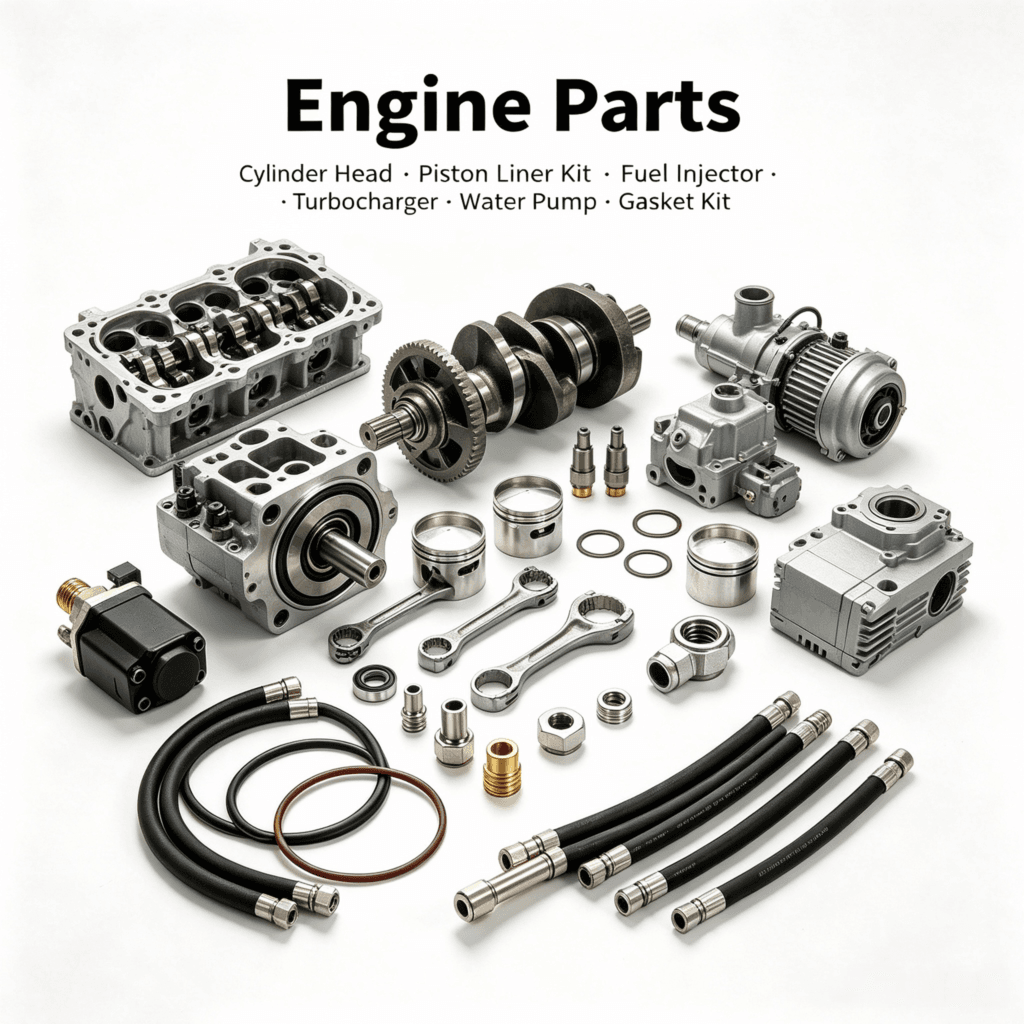
A: Tatan Machinery supplies complete diesel engine rebuild components, including piston kits (with rings and pins), forged crankshafts, centrifugally cast cylinder liners, multi-layer steel head gaskets, cylinder heads, camshafts, and auxiliary fuel system seals.Q: How do I verify engine part compatibility without an Engine Serial Number (ESN)?
A: If the ESN plate is missing, you can send us your machinery model, the stamped casting numbers on the engine block, cylinder head, or crankshaft journals, and photographs of the parts. Our technical desk will cross-reference these identifiers to verify the fitment.Q: What materials are used for your cylinder liners to resist wear?
A: Our cylinder liners are cast using high-grade pearlitic iron alloy and finished with centrifugal casting and plateau-honing techniques. This creates micro-cross-hatch textures that retain lubricating oil, reducing ring-to-liner friction and oil consumption.Q: Do your overhaul gasket sets include all seals for a complete rebuild?
A: Yes. Our complete overhaul gasket sets contain the multi-layer steel (MLS) head gasket, front and rear crankshaft oil seals, valve stem seals, intake and exhaust manifold gaskets, oil pan gaskets, and all necessary O-rings to seal fluid passages.Q: What is the standard break-in procedure after replacing pistons and liners?
A: We recommend running the rebuilt engine under varying moderate loads rather than idling for extended periods. This helps the piston rings seat correctly against the honed liner walls, preventing cylinder glazing and establishing optimal compression boundaries.
A Guide to Engine parts and Their Uses
Construction Machinery Engine Parts Applications
Earthmoving & General Utility
Maintains high compression and thermodynamic efficiency in standard digging, loading, and traveling duty cycles.
Heavy-Duty Mining & Excavation
Resists structural fatigue and extreme combustion temperatures under continuous high-load rock quarrying operations.
Fleet Overhaul & Rebuild Services
Provides direct-fit pistons, liners, and gasket kits to support comprehensive engine overhauls in rebuild workshops.
Commercial Rental Fleet Maintenance
Maintains engine uptime and preserves residual fleet values by matching original manufacturer rebuild specifications.
A Comprehensive Guide to Heavy Equipment Diesel Engine Rebuild Parts
The heavy-duty diesel engine is the power core of tracked excavators and bulldozers, translating thermal combustion energy into mechanical torque to drive main hydraulic systems. Constant high-temperature cycles, friction, and combustion soot eventually wear down piston rings, cylinder liners, crankshaft journals, and gaskets. Sourcing high-quality engine components ensures balanced compression, limits blow-by gases, and prevents internal oil and coolant leaks."As documented in Cummins Engine Technical Bulletins: 'Cylinder liner protrusion and proper piston ring end-gap alignment are critical to establish combustion chamber thermal boundaries, preventing dynamic blow-by gases from diluting crankcase lubricating oils and extending engine service life.'" — Official Source: Cummins Diesel Engine Rebuild Standards
Popular Heavy Equipment Engine Component Series We Support
Below is a summary of the core diesel engine wear parts and rebuild components supported by Tatan Machinery:| Component Category | Engineering Function in Heavy Machinery | Available Rebuild Specifications |
|---|---|---|
| Piston Kit | Converts extreme combustion pressure into linear mechanical motion | Alloy aluminum with steel-insert grooves, nitrided rings |
| Crankshaft | Transmits linear piston forces to the main hydraulic pump coupling | Forged alloy steel, induction hardened journals (HRC 58-62) |
| Overhaul Gasket Set | Seals cylinder blocks, heads, and manifolds to prevent fluid leaks | Multi-Layer Steel (MLS) head gaskets, high-temp fluorocarbon |
| Cylinder Head | Houses intake/exhaust valves and serves as the combustion chamber roof | Alloy cast iron, precision-ground surface flatness |
| Camshaft | Controls valve timing to coordinate intake and exhaust cycles | Carburized steel lobes, precision-ground timing geometries |
| Cylinder Liner Kit | Restores worn engine cylinders and guides dynamic piston travel | Centrifugally cast pearlitic iron, plateau-honed cross-hatch |
1. Caterpillar (CAT): 320D (C6.4 Rebuild Kit), 323D, 330D (C9 Piston & Gasket), 336D (C9.3 Liner Kit), D6T (C9) Rebuild Parts
2. Komatsu: PC200-8 (6D107 Overhaul Kit), PC220-8, PC300-8 (6D114 Crankshaft), PC400-8 Piston & Segment Sets
3. Isuzu Engine Series: 4HK1 (ZX200-3 Overhaul Kit), 6HK1 (ZX330-3 Liner Set), 6WG1, 4JG1 Cylinder Liner Rebuild Kits
4. Yanmar Engine Series: 3TNV88, 4TNV88, 4TNV94L, 4TNV98 (ViO55 Overhaul Gasket & Piston Rebuild Sets)
5. Cummins Engine Series: 6BT5.9, 6CT8.3, QSB6.7, QSL9 (Heavy Excavator Rebuild Gasket Packs & Pistons)
6. Deutz Engine Series: D2011, BF4M2012, TCD2013 (Road Roller & Compact Excavator Liner Rebuild Parts)
7. Mitsubishi Series: S4S, S6S, 6D16, 6D34 (Crawler Excavator & Forklift Gasket Rebuild Kits)
8. Kubota Series: V1505, V2203, V2403, V3307 (Mini Excavator Piston Rebuild Kits & Liners)
9. Perkins Series: 1104C, 1106C, 1106D (Backhoe Loader & Telehandler Overhaul Rebuild Parts)
10. Hino Series: J05E, J08E (Kobelco SK200-8 & SK350-8 Excavator Crankshafts & Liner Assemblies)
Key Takeaways for Sourcing Engine Rebuild Components
- Centrifugal Casting Technology: Cylinder liners are centrifugally cast and plateau-honed to preserve a durable oil lubrication layer.
- Nitrided Piston Ring Sets: Piston rings with gas-nitrided finishes resist micro-welding and high thermal wear in combustion chambers.
- Multi-Layer Steel Gaskets: Head gaskets utilize spring-steel multi-layers with elastomer coatings to maintain sealing pressure.
- Bearing Shell Clearance: Main and rod bearings must be precision-machined to hold strict clearances and prevent engine seizure.
- Engine Serial Number (ESN) Match: Checking ESNs and casting numbers helps ensure correct part dimensions and component fits.
Technical Parameters of Excavator Engine Overhaul Components
Piston Alloy and Cylinder Liner Material Standards
Diesel engine overhaul parts must withstand high combustion pressures. Premium piston kits feature reinforced ring grooves to minimize ring land scuffing, while cylinder liners are plateau-honed to establish optimal oil retention.| Engine Component Metric | Engineering Standard & Material Specification |
|---|---|
| Piston Base Material | Eutectic Aluminum-Silicon Alloy (Ni-resist ring groove inserts) |
| Crankshaft Hardness | HRC 58 – 62 (Nitrided and induction-hardened main/pin journals) |
| Cylinder Head Flatness Limit | Maximum distortion limit of < 0.05 mm across the entire mating surface |
| Gasket Compound | Multi-Layer Steel (MLS) with high-temperature fluorocarbon coatings |
Diesel Engine Mechanical Tolerance Standards
| Engine Spec Metric | Mini Engines (3 - 8T Class) | Medium Engines (13 - 22T Class) | Heavy Mining Engines (> 30T Class) |
|---|---|---|---|
| Piston-to-Liner Clearance | 0.05 – 0.08 mm | 0.09 – 0.12 mm | 0.14 – 0.18 mm |
| Top Compression Ring End-Gap | 0.20 – 0.35 mm | 0.30 – 0.45 mm | 0.40 – 0.60 mm |
| Cylinder Liner Protrusion | 0.03 – 0.07 mm | 0.04 – 0.09 mm | 0.05 – 0.11 mm |
| Crankshaft Journal Ovality Limit | < 0.005 mm | < 0.008 mm | < 0.010 mm |
Technical Feature Matrix: Cat C6.4 & Komatsu 6D107 Overhaul Standards
Below is a detailed technical comparison of two common excavator diesel engines:| Technical Feature | Engineering Specification & Operational Standard |
|---|---|
| Standard Engine Models | Caterpillar C6.4 (320D Excavator) / Komatsu 6D107 (PC200-8 Excavator) |
| Cylinder Configuration | 6-Cylinder, in-line, water-cooled turbo diesel engines |
| Bore & Stroke | Cat C6.4: 102mm x 130mm / Komatsu 6D107: 107mm x 124mm |
| Head Gasket Specifications | Multi-Layer Steel (MLS) structure with high-temp elastomer coatings |
| Valve Train Clearance (Cold) | Intake: 0.25–0.30 mm / Exhaust: 0.50–0.55 mm |
Practical Guide to Sourcing Heavy Equipment Engine Rebuild Parts
1. Verifying Part Hardness Standards & Dimensional Tolerances
When sourcing engine overhaul kits internationally, material hardness is critical. Partner with suppliers who utilize high-grade alloy components with verified induction-hardened profiles. Tatan Machinery subjects all dynamic rebuild components to strict metallurgical checks and dimensional audits prior to export."As documented in Isuzu Engine Rebuild Manuals: 'Precision crankshaft journal tolerances and cylinder liner roundness are essential to maintain oil film thickness, preventing metal-to-metal contact and avoiding bearing failure under heavy load.'" — Official Source: Isuzu Commercial Vehicle Engine Maintenance Standards
2. Troubleshooting Premature Ring Wear (Crankcase Blow-By)
Excessive blow-by is typically caused by worn piston rings or glazed cylinder liner walls. Active technicians on Heavy Equipment Forums state: "Cylinder liner protrusion must be checked carefully during rebuild. Incorrect liner height ruins the head gasket seal, causing coolant leaks or combustion blow-by within 500 operating hours."3. Establishing Proper Engine Break-In Procedures
After completing an engine rebuild, proper break-in is essential. Avoid prolonged idling, as this can glaze cylinder liner cross-hatches. We recommend operating the engine under moderate, varying loads during the initial break-in period to seat the piston rings correctly against the honed liner walls.Why Choose Tatan Machinery: Engine Component Supplier Comparison
Below is a comparison showing why repair workshops, fleet managers, and mining operators trust Tatan Machinery over generic traders:| Key Metric | Tatan Machinery Standard | Typical Generic Traders | Buyer Advantage |
|---|---|---|---|
| Spool & Journal Hardness | Induction Hardened Crankshaft Journals (HRC 58-62) & Nitrided Rings | Soft/unhardened carbon steel surfaces | High fatigue resistance and low bearing wear |
| Liner Rebuild Quality | Centrifugally cast plateau-honed liners for optimum oil retention | Smooth-bored cast liners (low lubrication oil retention) | Lower oil consumption and ring scuffing |
| Dynamic Tolerance Controls | 100% Dimensional checks against original equipment standards | Visual inspection / Basic measurements only | Ensures component performance upon installation |
| Technical Support | Engine Rebuild Specialists (ESN Matching < 1 Hr) | Standard Sales Representatives | Accurate parts selection and troubleshooting |
| Export Packaging | VCI anti-rust films + robust steel-banded wooden boxes | Standard cardboard / loose cartons | Zero transit rust or damage to journals |